vitals
Type-safe Apple Health and Health Connect. Bucketed statistics computed natively, and writing verified end to end on iOS.
vitals
Type-safe access to Apple Health and Health Connect.
final steps = await Vitals.instance.read(
  VitalType.steps,
  from: weekAgo,
  to: now,
);
// List<CountSample> — steps.first.count is an int.
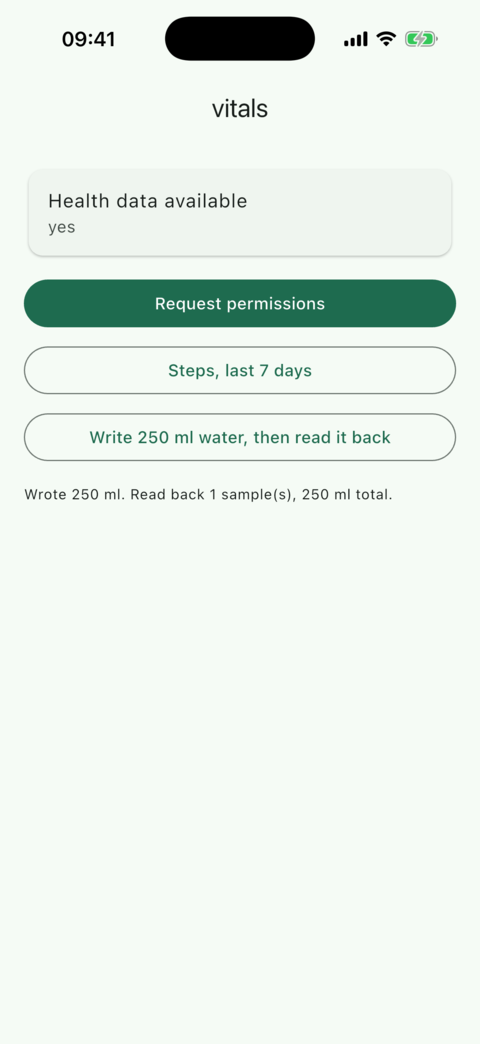
Status. Reading is verified against a real HealthKit store, and the Dart contract has a full unit-test suite behind it. Writing is verified on iOS, end to end: 250 ml of water written and read back at the same value and unit. Earlier versions of this file said writing had never been observed to work and blamed the Simulator. That was wrong — the fault was in this package's own example, whose entitlements file was never wired into its Xcode project, so the app was built without the HealthKit entitlement and every write was refused. See iOS setup; it is an easy mistake to repeat. Android is still unverified. The Health Connect round trip has not been run. If you write on Android, check the values land before trusting them — a unit-conversion mistake would be silent, and health records are awkward to correct.
Why another one
health is the established package, it is actively maintained, and it covers more data types than this does. If you need breadth today, use it. This exists for three things it does not do.
Nothing is cast. The type you ask for decides the type you get back:
final weight = await Vitals.instance.read(VitalType.bodyMass, from: a, to: b);
weight.first.value.pounds;   // a Mass, not a double you hope is kilograms
Permissions are modelled on what the platforms can actually answer. There is deliberately no readAccess(), because HKAuthorizationStatus has exactly three values and all three describe writing:
HKAuthorizationStatusNotDetermined
HKAuthorizationStatusSharingDenied
HKAuthorizationStatusSharingAuthorized
Apple omits read status on purpose — knowing which health types someone has recorded would itself disclose health information. So any API that answers "do I have read permission?" is guessing on iOS. This one doesn't ask.
Health flows are testable. FakeVitals runs the entire API in memory.
The three permission states
Running against a real store turned up something worth encoding: HealthKit distinguishes never asked from asked and refused, and only the second is silent.
| State | What a read does |
|---|---|
| Never requested | throws AuthorizationNotDeterminedException |
| Requested, granted | returns data |
| Requested, refused | returns empty — indistinguishable from no data |
So the exception means your app forgot to call requestPermissions, which is a bug you can fix. Emptiness afterwards is genuinely ambiguous, on every package, forever. Write your UI accordingly:
switch (await Vitals.instance.readAccessOnAndroid({VitalType.steps})) {
  case null:            // iOS: unknowable, attempt the read and handle empty
  case final access:    // Android: an actual answer
}
Writing
There is one method per kind of quantity, and the compiler picks it for you — each VitalType is generic over its sample type, so a mismatch does not compile:
await vitals.writeMass(VitalType.steps, const Mass.kilograms(71.2), at: now);
// error: VitalType<CountSample> can't be assigned to VitalType<MassSample>
The unit is part of the value rather than a separate argument, so there is no way to pass kilograms and mean pounds:
await vitals.writeMass(VitalType.bodyMass, const Mass.kilograms(71.2), at: now);
await vitals.writeVolume(VitalType.water, const Volume.millilitres(250), at: now);
Some quantities happen at an instant, others accumulate over a period, and the signature says which:
// over a period
await vitals.writeCount(VitalType.steps, 2400, from: earlier, to: now);
await vitals.writeLength(
  VitalType.distanceWalkingRunning, const Length.metres(1800),
  from: earlier, to: now,
);

// at an instant
await vitals.writeRate(VitalType.heartRate, 62, at: now);
await vitals.writePercent(VitalType.oxygenSaturation, 0.98, at: now);
| the type you have | the method | the value |
|---|---|---|
VitalType<CountSample> | writeCount | int, over a period |
VitalType<MassSample> | writeMass | Mass, at an instant |
VitalType<LengthSample> | writeLength | Length, over a period |
VitalType<EnergySample> | writeEnergy | Energy, over a period |
VitalType<RateSample> | writeRate | double per minute, at an instant |
VitalType<PercentSample> | writePercent | double fraction, at an instant |
VitalType<VolumeSample> | writeVolume | Volume, at an instant |
Every snippet above is compiled against the real API by test/readme_examples_test.dart, because the previous version of this section documented signatures that did not exist.
Statistics, not raw samples
A year of heart-rate readings is hundreds of thousands of points. Reducing them on the platform beats shipping them across the channel:
final daily = await Vitals.instance.statistics(
  VitalType.steps,
  from: monthAgo,
  to: now,
  bucket: VitalBucket.daily,
);
Each type knows how it should be reduced — steps sum, heart rate averages, weight takes the latest — so you rarely pass aggregate yourself. A bucket with no samples reports null, never 0; conflating those is how averages go wrong.
Testing
final vitals = FakeVitals()
  ..seedCounts(VitalType.steps, {
    DateTime(2026, 8, 24): 8210,
    DateTime(2026, 8, 25): 11430,
  });
It models the awkward states too, not just the happy path:
FakeVitals(available: false);              // ineligible device
FakeVitals(permissionSheetSucceeds: false); // user dismissed the sheet
FakeVitals(readsAreBlocked: true);          // the iOS silent denial
iOS setup
Three things, all required, none of them optional:
1. Add the HealthKit capability in Xcode, or an entitlements file:
<key>com.apple.developer.healthkit</key>
<true/>
2. Add both usage descriptions to Info.plist. Omitting either crashes the app the moment you request that kind of access:
<key>NSHealthShareUsageDescription</key>
<string>Why you read health data.</string>
<key>NSHealthUpdateUsageDescription</key>
<string>Why you write health data.</string>
3. Minimum iOS 15. Sleep stages finer than "asleep" and workout totals need iOS 16; below that they degrade rather than failing.
Wire the entitlements file into the project, not just into the folder. Adding the capability through Xcode's Signing & Capabilities tab does this for you. If you create Runner.entitlements by hand — or copy one in — you must also set CODE_SIGN_ENTITLEMENTS in the build settings, or the file is simply ignored:
CODE_SIGN_ENTITLEMENTS = Runner/Runner.entitlements;
Without it the app builds and runs, reads may appear to work, and every write fails with Not authorized. This package's own example had exactly that mistake, and it cost several releases of a README claiming writes were unverified.
Android setup
Health Connect requires minSdk 26, and the permissions your app uses must be declared in AndroidManifest.xml. Health Connect is built in from Android 14; older devices need it installed from the Play Store, which isAvailable() reports.
Two types are unsupported here and say so rather than returning something close: mindfulSession, which Health Connect does not model, and basalEnergyBurned, whose nearest record is a rate rather than an interval total.
License
MIT © K M Shahriar Hossain