fit_text
Text that shrinks to fit its box, correctly. Works inside Expanded, Row, IntrinsicHeight and unbounded constraints, where LayoutBuilder-based auto-sizing gives up.
fit_text
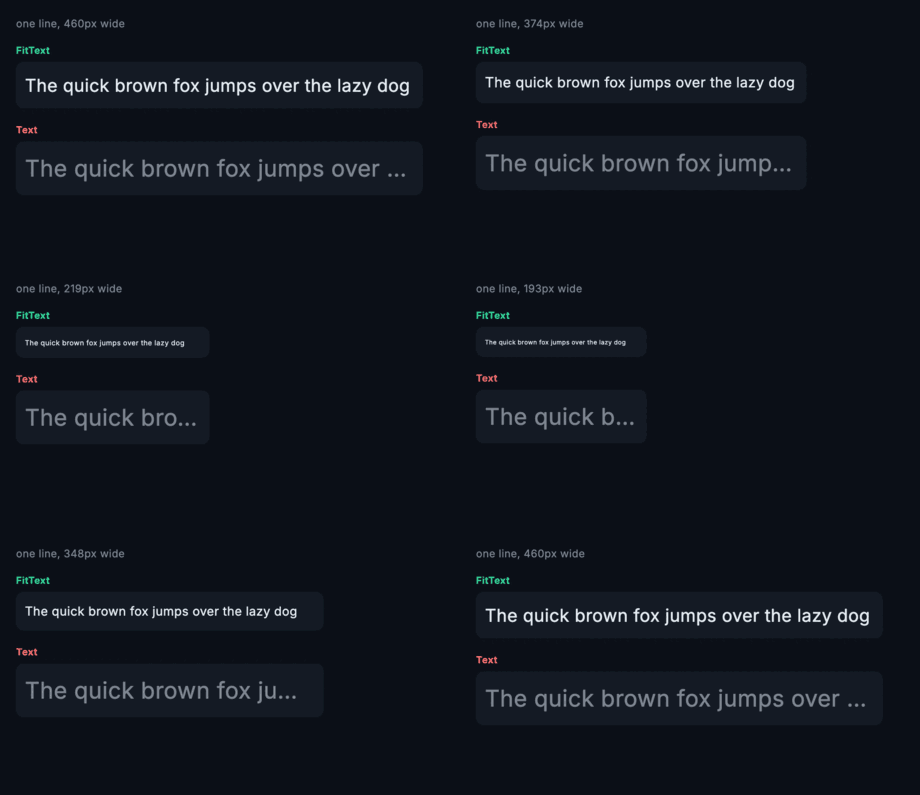
Text that shrinks to fit its box — including in the places auto-sizing usually breaks.
FitText('A headline that must never wrap', maxLines: 1, minFontSize: 12)
The problem this fixes
Flutter has no built-in way to make text fit: Text overflows or clips. The established workaround measures inside a LayoutBuilder, and that works right up until the widget lands somewhere Flutter needs an intrinsic size first:
LayoutBuilder does not support returning intrinsic dimensions.
  at _RenderLayoutBuilder.computeMaxIntrinsicHeight
That is a hard framework limitation, not a bug someone forgot to fix. It rules LayoutBuilder-based auto-sizing out of:
IntrinsicHeightandIntrinsicWidthTablecells — columns size with intrinsics by default- Baseline-aligned rows
FitText does the fitting inside its own RenderBox, during layout. Intrinsics are answered honestly, so it works in all of those. There is a test in the suite that pins the LayoutBuilder failure alongside FitText succeeding in the same tree, so the difference is verified rather than asserted.
Install
dependencies:
  fit_text: ^0.2.0
Usage
// Shrink to fit one line, never below 12.
FitText('Long product name', maxLines: 1, minFontSize: 12);

// Grow to fill, but stay on your type scale.
FitText('42', presetFontSizes: [16, 24, 32, 48, 64]);

// Rich text — nested sizes scale proportionally.
FitText.rich(
  TextSpan(text: 'Total ', children: [
    TextSpan(text: '£42', style: TextStyle(fontWeight: FontWeight.bold)),
  ]),
  maxLines: 1,
);
Both constructors are const, like Text.
Matching sizes across widgets
Independently fitted labels land on different sizes, which looks wrong across a row of buttons. A group makes them agree on the smallest size any member needed, so they match and all of them still fit.
final labels = FitTextGroup();   // hold this in state

Row(children: [
  Expanded(child: FitText('Save', group: labels, maxLines: 1)),
  Expanded(child: FitText('Discard changes', group: labels, maxLines: 1)),
]);
Members find their own size first and agree on the next frame, so a group settles one frame after its contents change.
Options
minFontSize | Floor. Below this the text overflows instead of shrinking further. |
maxFontSize | Ceiling. Defaults to the inherited style's size, so text shrinks but never grows unless you ask. |
stepGranularity | Increment between candidate sizes. |
presetFontSizes | An explicit scale, instead of a stepped range. |
group | Share a size with other members. |
Everything Text takes — textAlign, maxLines, softWrap, overflow, strutStyle, textScaler, locale, textWidthBasis — behaves the same way.
Cost
Finding the size is a bisection, not a scan: about log2((max - min) / step) text layouts, so six or so for the defaults. It re-runs only when the text, style, or constraints change, and RenderFitText.fittedFontSize exposes what it chose if you need to react to it.
Coming from auto_size_text
The API is deliberately close, so most call sites change only the widget name.
| auto_size_text | fit_text |
|---|---|
AutoSizeText(...) | FitText(...) |
AutoSizeText.rich(...) | FitText.rich(...) |
AutoSizeGroup() | FitTextGroup() |
group: myGroup | group: myGroup |
| overflowReplacement: | overflowReplacement: |
| wrapWords: false | wrapWords: false |
Neither package supports text selection.
One difference worth knowing: overflowReplacement stays mounted whether or not it is used, collapsed to zero size — the same trade IndexedStack makes. That is what lets the swap happen inside a single layout pass with no frame of overflowing text, but it means an expensive replacement widget is built even when it never shows. Keep it cheap.
License
MIT © K M Shahriar Hossain