document_pip
Put live Flutter widgets in a real always-on-top OS window from Flutter Web, using the Document Picture-in-Picture API and Flutter's multi-view engine.
document_pip
Live Flutter widgets in a real, always-on-top operating-system window — from Flutter Web.
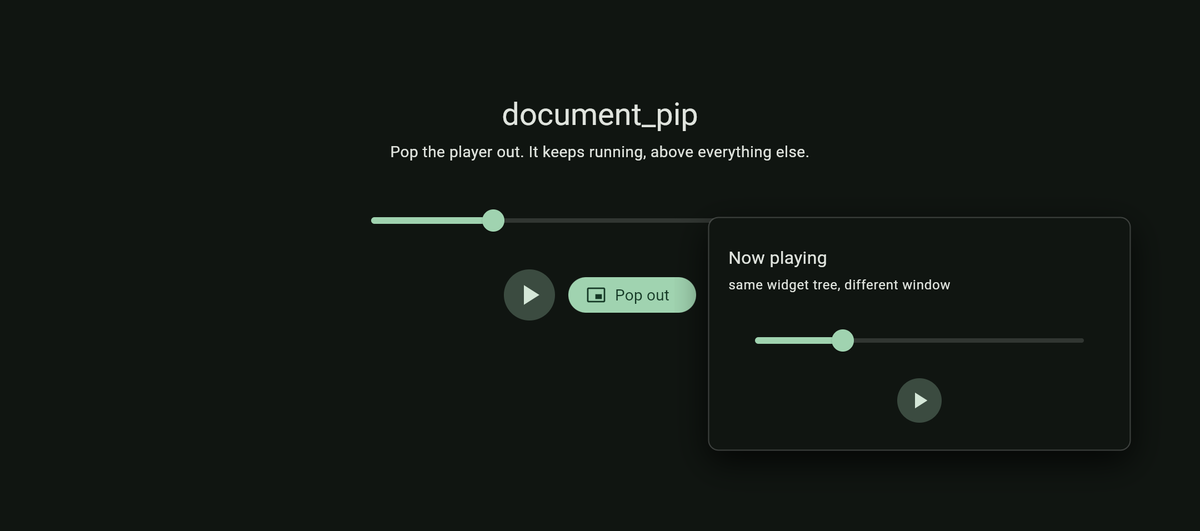
Two windows, one widget tree. The pop-out is a real OS window — it stays above every other application, and it keeps running when you switch tabs.
Not a widget floating inside your app. An actual window the browser owns, which stays above your editor, your terminal and every other application, while your app keeps running with its state intact.
void main() => runWidget(
  DocumentPipApp(
    main: (context) => const MaterialApp(home: Player()),
    popOut: (context) => const MaterialApp(home: MiniPlayer()),
  ),
);

// ...in a button handler:
final window = await DocumentPip.open(width: 380, height: 210);
await window.closed;
State lifted above DocumentPipApp is shared, so both windows are looking at the same objects. Scrub in one and the other moves, because there is only one.
Two things this needs that a normal package does not
Multi-view is a property of how the engine starts, so it cannot be switched on from inside a package. Both of these are one-time, and the errors tell you if you miss them.
1. runWidget, not runApp. Multi-view Flutter has no single root.
2. A bootstrap that turns multi-view on and hands over the app runner. Only the JS app object returned by engine.runApp() can add a view — dart:ui_web exposes the views read-only — so it has to be reachable. In web/flutter_bootstrap.js:
{{flutter_js}}
{{flutter_build_config}}

_flutter.loader.load({
  config: { multiViewEnabled: true },
  onEntrypointLoaded: async function (engineInitializer) {
    const engine = await engineInitializer.initializeEngine({
      multiViewEnabled: true,
    });
    const app = await engine.runApp();
    window.documentPipApp = app;          // <- document_pip needs this

    // In multi-view mode no view is created for you.
    app.addView({ hostElement: document.querySelector('#app') });
  },
});
and give web/index.html a host to point at:
<body style="margin:0;height:100%">
  <div id="app" style="position:absolute;inset:0"></div>
</body>
Forget the bootstrap and DocumentPip.open() throws DocumentPipNotBootstrapped, whose message is this snippet verbatim — a test keeps the two identical. Forget runWidget and you never get that far: Flutter itself refuses to start and names the fix.
Never pass document.body as the host. Flutter clears a host element's children and sizes the view to 100% of it, so body wipes your page — script tags included — and then measures zero.
Install
flutter pub add document_pip
Opening the window
if (!DocumentPip.isSupported) return;   // see browser support below

final window = await DocumentPip.open(
  width: 380,
  height: 210,
  copyStyles: true,             // the new document starts with none
  disallowReturnToOpener: false,
  preferInitialWindowPlacement: false,  // true to ignore the remembered size
);

window.viewId;                  // the Flutter view rendering inside it
window.isOpen;
await window.closed;            // however it closed
await window.close();
open() must be the first await in a user-gesture handler. The browser only allows this while handling a real click, tap or key press, and awaiting anything beforehand spends that gesture. Load your data afterwards:
onPressed: () async {
  final window = await DocumentPip.open();   // first
  final data = await fetchTrack();           // then
}
Get that wrong and you get DocumentPipDenied. Chrome refuses for three reasons and calls all of them NotAllowedError, so the message lists them and quotes Chrome's own text, which is the part that actually discriminates. The other common one is calling from inside an iframe.
It keeps running when you switch tabs
Which is the whole point, and is not free. Chromium keeps painting the page that owns a picture-in-picture window even when its tab is in the background — but it still reports that page as hidden, and Flutter responds to hidden by switching frames off. Left alone, the floating window freezes the instant you look at something else.
DocumentPipApp is what stops that, by forcing frames for exactly as long as the page is hidden and a window is open. Measured in Chrome 152: 0 frames in three seconds before, 311 after. If you build your own ViewCollection instead of using this root, you will need to do the same thing.
Firefox does not have the problem. Measured the same way in 151 and 155: with a pop-out open it keeps reporting the opener visible and runs it at full rate (308 animation frames in 2.5s, against 9 for the same page with no pop-out), so Flutter never switches frames off. The workaround is gated on frames actually being disabled, so in Firefox it costs nothing and never runs.
The keyboard works in there
Also not free. Flutter binds the keyboard once, to the page's own window, so a pop-out is not on the path — Shortcuts, Actions, Focus.onKeyEvent, Escape and Tab traversal receive nothing, while plain typing keeps working because the browser routes characters to the focused element itself. This package replays key and selection events into the opener and hands Flutter focus to the pop-out's view when the window takes it.
One window, browser-wide
A browser permits exactly one picture-in-picture window at a time, across every tab. Opening a second closes the first, including one belonging to a different site. DocumentPip.current is how you notice, and window.closed completes when yours is displaced.
Errors
try {
  await DocumentPip.open();
} on DocumentPipUnsupported {
  // Safari, Firefox for Android, or not the web at all.
} on DocumentPipNotBootstrapped {
  // The bootstrap above is missing. The message is the snippet.
} on DocumentPipDenied catch (e) {
  // The browser said no. Its own reason is in e.message — most often the
  // user-gesture rule, but an iframe gets refused too.
}
All three extend DocumentPipException, which is sealed, so a switch over a failure is exhaustive and a new case is a compile error rather than a silent fall-through.
What this does not do
Desktop Chromium and Firefox 151+. Chrome and Edge have had Document Picture-in-Picture since 116; Firefox shipped it in 151 on 2026-05-19. Safari and Firefox for Android have no implementation, and neither does any non-web platform. DocumentPip.isSupported is a feature detect, so it is true wherever the API exists — gate the control on it rather than showing a button that always fails.
pub.dev lists this as a web package for that reason, but it still compiles everywhere. A conditional export keeps a cross-platform app building; off the web isSupported is false and open() throws, so the gate above is all you need and nothing else has to change.
Both engines were verified for this release, by running the example in each: Chrome 152, and Firefox 151.0 and 155.0.1. In Firefox the pop-out opens at exactly the size requested, Flutter adds its view inside the new document and paints there, and the keyboard bridge replays keys into the opener correctly. Safari and Firefox for Android have no implementation to test.
Not video picture-in-picture. If you want the OS video PiP that Android and iOS have, this is the wrong package — on Android try floating or simple_pip_mode; both are Android-only, and on iOS the system only offers PiP for video playback, not arbitrary UI. This renders arbitrary widgets, and only on the web.
The window is the browser's, not yours. It decides the real size, remembers what the user resized it to, and can close it whenever it likes. Treat width and height as a request.
No nested pop-outs. One window, browser-wide, is the platform's rule.
Hot restart orphans the window. Nothing here hooks hot restart, so after one the browser's window is still on screen, frozen, while current reports null. Close it by hand. Development only — a released app never hot restarts.
The window renders at the page's pixel ratio. Flutter's web engine keeps one display object for the whole app, so dragging the pop-out onto a monitor with a different density does not re-rasterise it, and no metrics event fires. Not fixable from a package.
Clipboard fails while the pop-out has focus. Chrome rejects a clipboard read from a document that is not focused, and the engine's clipboard is the page's. Copy from the page, not from the window.
Use a plain Navigator in popOut. Route information travels on one global channel that writes the page's history, so two MaterialApp.routers will fight over the URL.
Browser defaults still fire inside the pop-out. The bridge asks the engine whether Flutter consumed a key and mirrors that back, but measured against a real Shortcuts handler the engine does not report consumption — the action runs and the event stays un-prevented. So a shortcut you handle in Dart may also do whatever the browser would have done. The pop-out is a real browser window and this release does not suppress that; the behaviour is pinned by a test, so if the engine changes it will be noticed rather than assumed.
Replayed keys reach your page's own listeners too. Keys are replayed into the opener's <body> and bubble to document and window, so a page that mixes Flutter with its own markup will see its global shortcuts fire for keys typed in the pop-out. Scope those listeners to your own subtree.
One console warning per window. Chrome logs ResizeObserver loop completed with undelivered notifications when a window opens. It comes from Flutter's own observer on a newly added view host, not from this package — a picture-in-picture window built with identical markup but no Flutter view logs nothing. It means notifications were deferred a frame, not lost, and nothing here can suppress it.
---
Not affiliated with Google or the Flutter team.