cross_tab
Coordinate the browser tabs of a Flutter Web app: send typed messages between them, know how many are open, and elect exactly one to do the work.
cross_tab
Coordinate the browser tabs of a Flutter Web app.
final tabs = CrossTab.open('my-app');

tabs.presence.listen((p) {
  if (p.isLeader) {
    startPolling();
  } else {
    stopPolling();
  }
});

tabs.messages.listen((m) => print('${m.from} said ${m.data}'));
tabs.send({'signedOut': true});
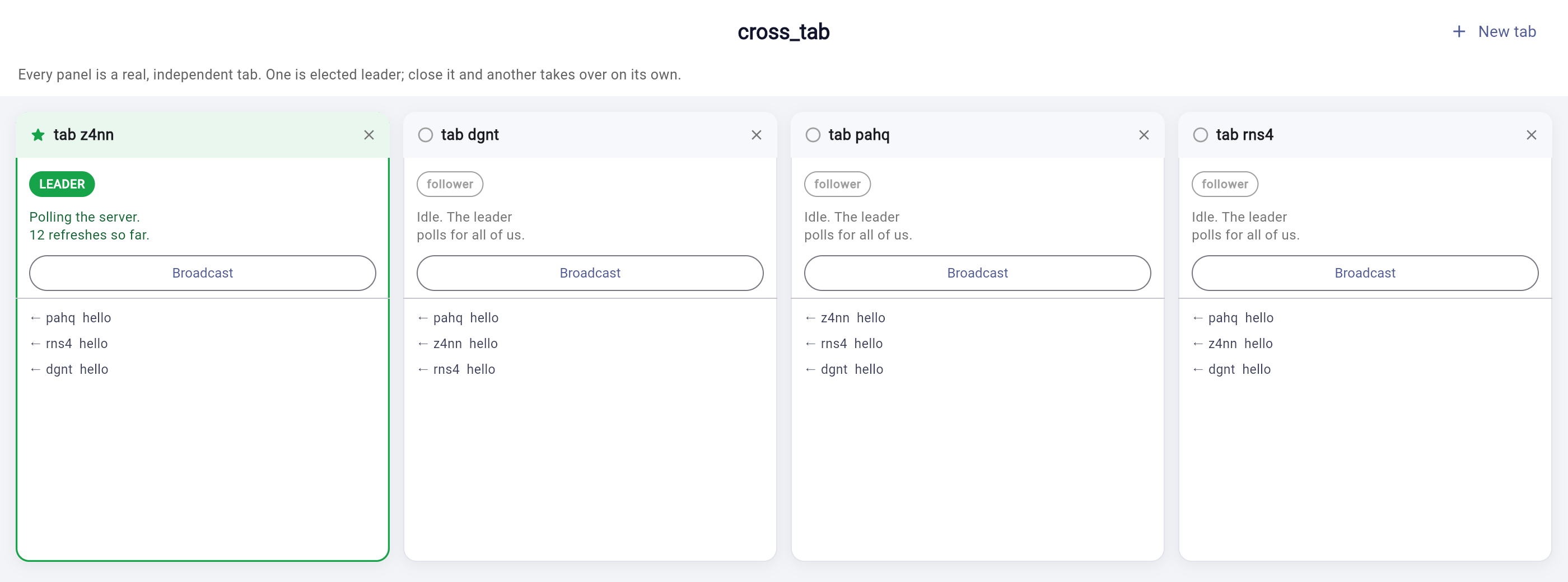
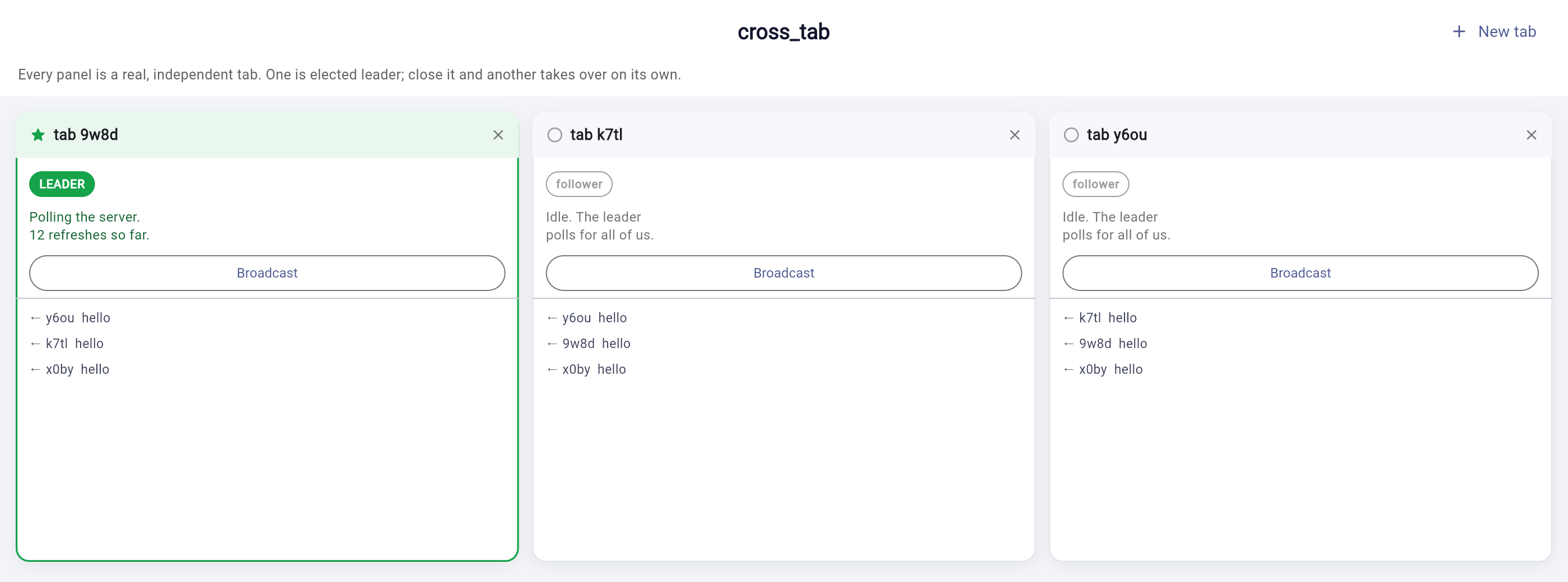
Every panel above is a real, independent tab. One is elected leader and does the polling; close it and another takes over on its own, keeping what it had already received.
The problem
Open your app in two tabs and things start going wrong quietly. Both poll the server. Both hold a socket. Both raise the same notification. The user signs out in one and the other carries on as though nothing happened.
The browser gives you BroadcastChannel and stops there. What is missing is everything around it.
| what you need | what the platform gives you |
|---|---|
| messages with a sender | untyped structured clones, no identity |
| how many tabs are open | nothing — you maintain it by heartbeat |
| exactly one tab doing the work | nothing at all |
A leader
This is the part worth the package. Exactly one tab should poll, hold the socket, or raise the notification — and when that tab closes, another must pick it up without being told.
tabs.presence.listen((p) {
  if (p.isLeader) {
    socket.connect();
  } else {
    socket.disconnect();
  }
});
The oldest tab leads, with the id as a tiebreak. That second part matters more than it looks: two tabs opened in the same microsecond would otherwise each conclude the other should lead, or both lead. Comparing ids makes the ordering total, so every tab reaches the same answer without further negotiation.
A tab that closes says goodbye, so the others react at once rather than waiting out a timeout. A tab that crashes says nothing, so it is dropped after three missed heartbeats.
Presence
final p = tabs.current;
p.count;     // how many tabs are open
p.tabs;      // their ids, including this one
p.leader;    // whose turn it is, or null while an election settles
p.isLeader;  // whether that is you
presence emits the current state on subscription, so a listener knows where it stands immediately rather than after the next change.
Messages
tabs.send({'cart': items.length});
tabs.messages.listen((m) => print('from ${m.from}: ${m.data}'));
A tab never receives its own messages — the sender already knows what it sent.
Off the web
The package compiles everywhere. On mobile and desktop there is exactly one instance of your app, so it reports one tab and is always the leader.
That is the correct answer rather than a degraded one, and it is deliberate: it means the code above runs unchanged on every platform, with no if (kIsWeb) wrapped around your leader logic.
Verified
Two BroadcastChannel objects with the same name see each other even within one document, so the multi-tab behaviour is exercised for real rather than mocked. flutter test --platform chrome covers four tabs agreeing on a single leader, the oldest tab winning, leadership passing when the leader closes, tabs discovering and losing each other, and a tab not hearing its own messages. The single-instance path is tested on the VM.
License
MIT © K M Shahriar Hossain